Monte Pratt / Creative Direction
Creative direction that survives reality.
I help organizations move from ambiguity to clarity — shaping the identity, the system, and the decisions that keep great creative work coherent as it scales.
My background spans brand architecture, design systems, production, physical environments, and ongoing stewardship. I care as much about how an idea behaves after approval as I do about the idea itself.
Selected Work / 01
The Team / Real Broker
From a generic phrase to an original identity, governed system, and scalable platform.
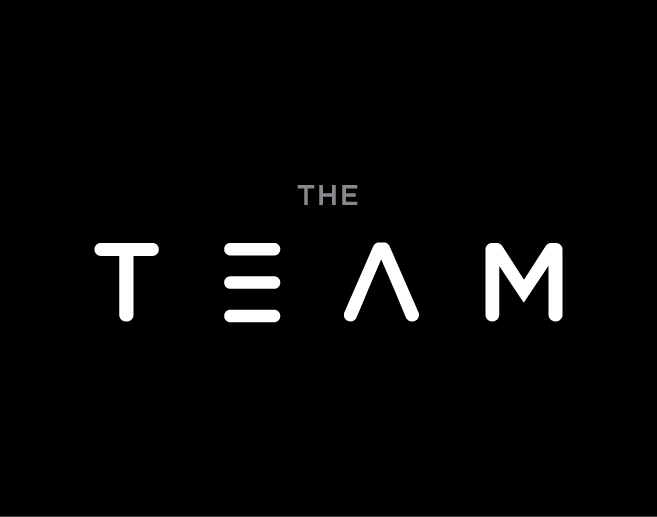
Cody Burger came to me with an established real estate organization operating under EXIT Unlimited and an emerging idea: become The Team.
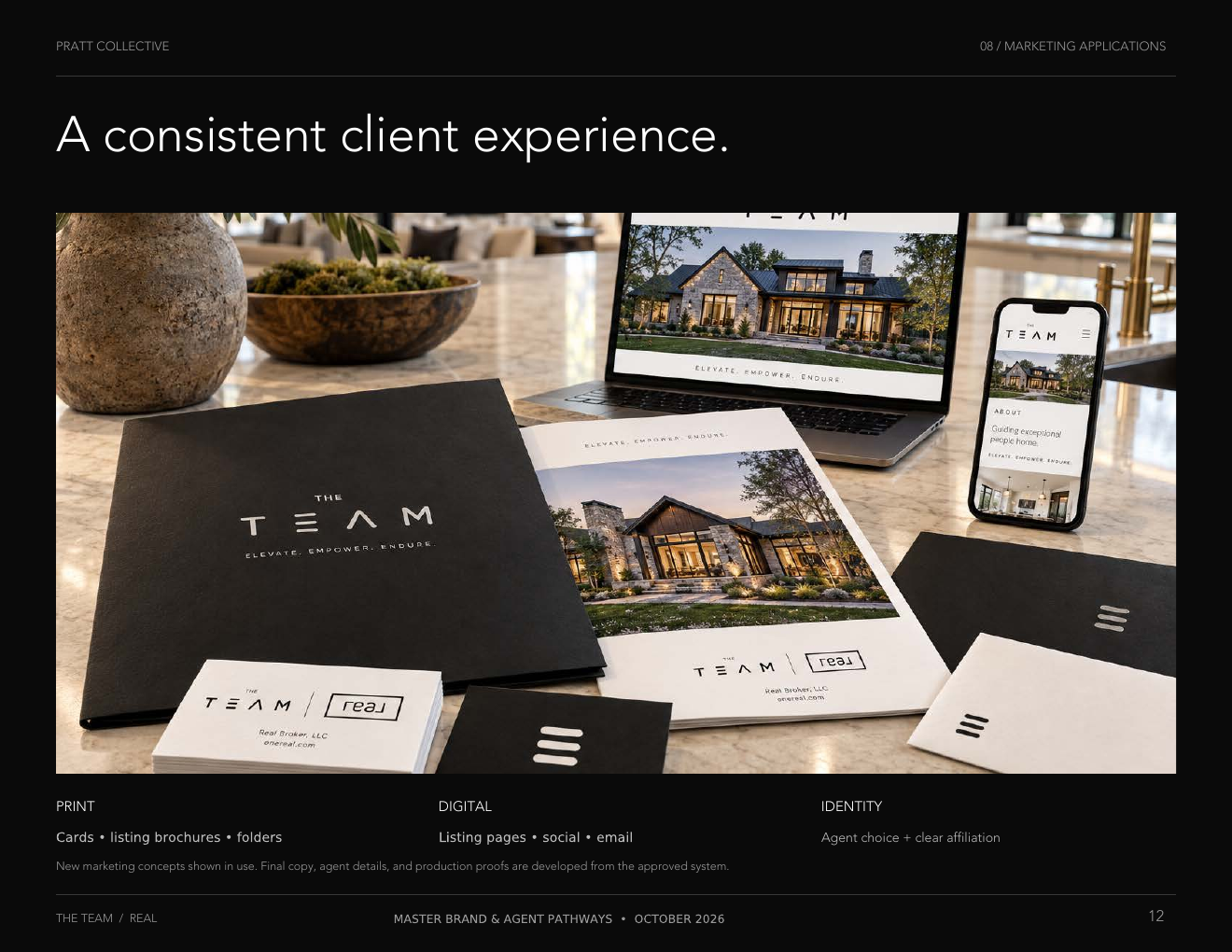
The name was broad. The opportunity was to make it specific. I developed the three-bar identity, defined its meaning, and then built the architecture around it so the brand could operate consistently through a brokerage transition, individual agent choices, campaign work, and deployment.
- Original identity development from an ambiguous starting point
- Three agent pathways + Real Broker integration
- Consistent use across print, digital, signage, and campaign
- Standards, boundaries, governance, and future stewardship
What this demonstrates: I can take something undefined, determine what it needs to become, establish the creative language, and build the framework that protects it once other people begin using it.
Selected Work / 02
Rachel Adams Lee
Ongoing governance of an established brand — and the trust to guide what grows around it.
Rachel represents what happens after an identity has been established: the transition from creating the system to continually stewarding it as the business grows and the brand is asked to do more.
I govern the Rachel Adams Lee Group identity across print, digital, signage, collateral, and new applications so that each decision reinforces the same recognizable system.
That relationship has expanded into Rachel’s adjacent ventures. I did not create each of those identities. The work is more nuanced: preserve their equity, improve their use, and help them operate coherently beneath Rachel’s broader brand ecosystem.
- Governance of the core Rachel Adams Lee Group brand
- Consistent deployment across physical and digital touchpoints
- Live Design guidance for adjacent ventures
- Distinct identities preserved without sacrificing coherence
What this demonstrates: Creative direction does not end when a brand launches. The deeper value is protecting its integrity, guiding expansion, and preventing complexity from becoming fragmentation.

Selected Work / 03
Selected Brand Systems
The problem is rarely the logo. The problem is the system around it.
Across decades of identity work, the recurring challenge has been the same: turn a visual idea into something usable, recognizable, and durable.
The work intentionally varies. I am not interested in forcing every client into one designer aesthetic. I am interested in discovering what belongs to the organization and establishing enough structure for that idea to survive real use.
What this demonstrates: I can personally establish the creative bar while building systems that teams, clients, and partners can carry forward without losing the idea.
The recurring question
What should lead?
What should stay?
What should change?
What should never drift?
The creative work is only the beginning. The system determines whether it remains coherent.
IDENTITY
Marks, typography, color, hierarchy, and recognition.
EXPERIENCE
Print, digital, environment, campaign, and customer touchpoints.
GOVERNANCE
Standards, boundaries, decisions, stewardship, and evolution.
How I Work
Clarity before output.
My process compresses the distance between ambiguity and execution without lowering the creative standard.
01
Clarify
Find the business truth, audience pressure,
constraint, and opportunity.
02
Structure
Define hierarchy, relationships, decisions,
ownership, and rules.
03
Design
Establish the visual and experiential standard
with enough range to scale.
04
Activate
Move the idea into channels, teams, partners,
and real-world touchpoints.
05
Steward
Protect the system, coach judgment,
and evolve it without drift.
Creative Leadership
My job is not to make everything. My job is to keep everything connected.
I am most valuable when the answer is not obvious — when creative quality, business priorities, people, systems, and execution all need to resolve into one coherent direction.
AI accelerates that work. It does not replace the judgment that decides what deserves to exist, what is ready to ship, or how a creative system should respond when the context changes.
I have spent decades making creative decisions survive customers, leadership opinions, production constraints, partners, deadlines, and commercial consequence. The work is not finished when the concept is approved. It is finished when the idea continues to hold together in the real world.